
Is a Payday Loan Installment or Revolving?
Understanding the Key Differences
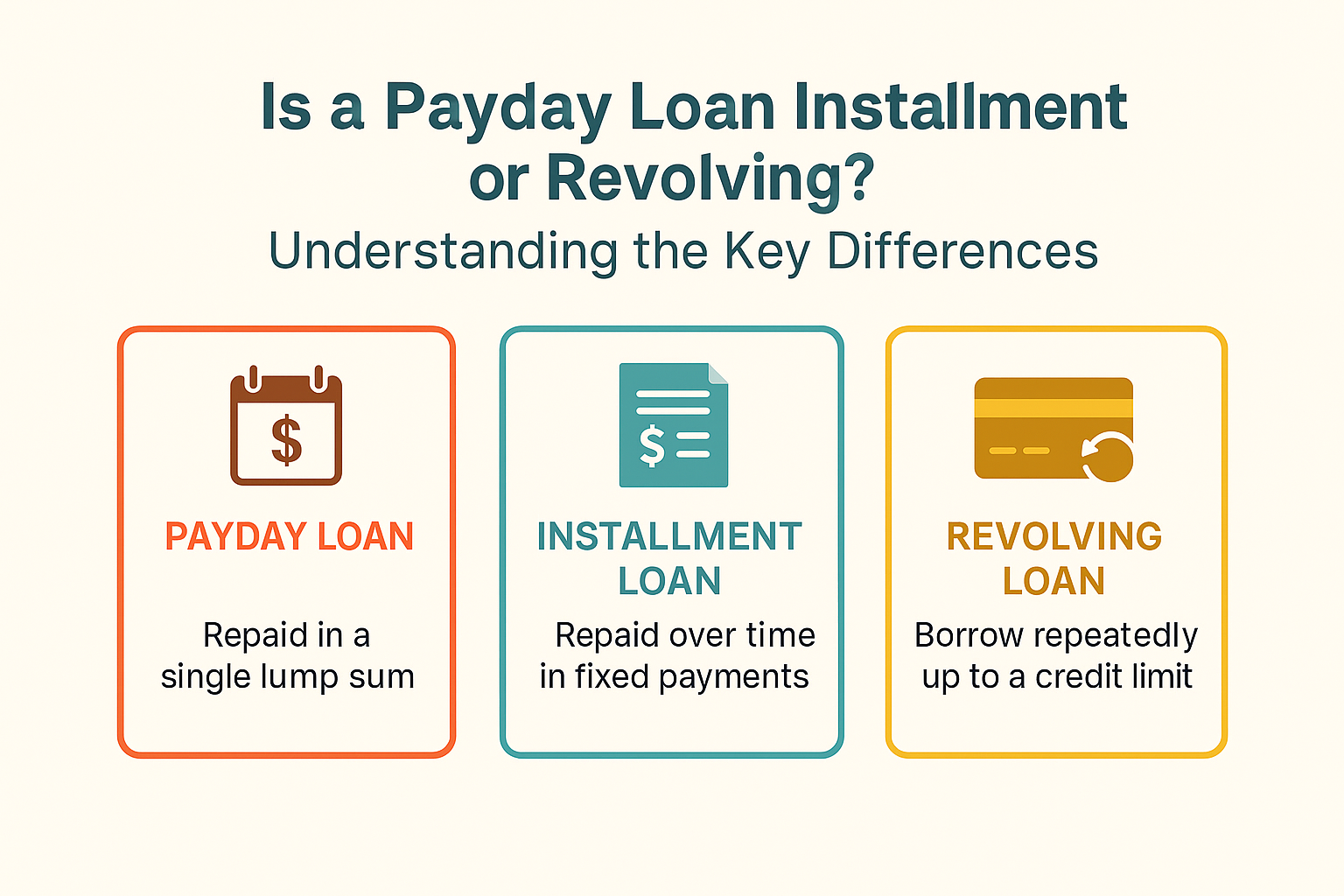
A payday loan is neither a traditional installment loan nor a revolving loan – it’s a unique type of short-term loan that typically requires full repayment in a single lump sum by your next payday. While payday loans share some characteristics with both loan types, they operate differently from traditional installment loans (which are repaid over time in fixed payments) and revolving credit (which allows you to borrow repeatedly up to a credit limit).
Understanding these distinctions is crucial when you’re facing a financial emergency and considering your borrowing options. Let’s break down what each type of loan really means and why the differences matter for your financial health.
What Exactly Is a Payday Loan?
Payday loans are short-term, high-cost loans designed to bridge the gap between paychecks. Here’s how they typically work:
- Loan amount: Usually $100 to $1,000
- Repayment term: Typically 2-4 weeks (until your next payday)
- Repayment structure: Full amount due in one lump sum
- Fees: Often $15-$30 per $100 borrowed
- APR: Can reach 400% or higher when annualized
The borrower writes a post-dated check or provides electronic access to their bank account for the loan amount plus fees. When the loan comes due, the lender cashes the check or withdraws the funds electronically. Read more about payday loans here.
Understanding Installment Loans
Installment loans work very differently from payday loans:
Key Characteristics:
- Repayment structure: Fixed payments over a set period (typically 6-60 months)
- Predictable payments: Same amount due each month
- Loan amounts: Can range from a few hundred to several thousand dollars
- Interest rates: Generally much lower than payday loans
- Credit reporting: Often reported to credit bureaus, helping build credit history
Example: A $1,000 installment loan at 36% APR over 12 months would require monthly payments of approximately $132, making it much more manageable than paying back $1,150 all at once in two weeks.
What Are Revolving Loans?
Revolving credit allows you to borrow money repeatedly up to a predetermined credit limit:
Common Examples:
- Credit cards
- Personal lines of credit
- Home equity lines of credit (HELOCs)
How They Work:
- You’re approved for a maximum credit limit
- You can borrow any amount up to that limit
- As you pay down the balance, that credit becomes available again
- You only pay interest on what you’ve borrowed
- Minimum monthly payments are typically 2-4% of the outstanding balance
Why the Distinction Matters
Understanding these differences is crucial because each loan type affects your finances differently:
Payment Burden
- Payday loans: Require large lump-sum payments that can be difficult to manage
- Installment loans: Spread payments over time, making them more affordable
- Revolving credit: Offer flexibility in payment amounts (though paying minimums can be costly long-term)
Cost Comparison
The true cost of borrowing varies dramatically:
- Payday loan: $300 loan for two weeks at $15 per $100 = $345 total cost (391% APR)
- Installment loan: $300 over 6 months at 25% APR = approximately $328 total cost
- Credit card: $300 at 18% APR paid over 6 months = approximately $315 total cost
Credit Impact
- Payday loans: Rarely help build credit; mainly reported if you default
- Installment loans: Regular reporting can improve your credit score with on-time payments
- Revolving credit: Significant impact on credit score based on utilization and payment history
The Payday Loan Trap
One of the biggest dangers of payday loans is the cycle of debt they can create. Since the full amount is due quickly, many borrowers find themselves unable to repay and end up “rolling over” the loan for additional fees. The Consumer Financial Protection Bureau found that 80% of payday loans are rolled over or renewed within 14 days.
Here’s how the cycle works:
- Borrow $300, owe $345 in two weeks
- Can’t afford full payment, so pay $45 fee to extend
- Two weeks later, still owe $300 plus another $45 fee
- Cycle continues, with borrowers paying more in fees than the original loan amount
Better Alternatives to Consider
If you need quick cash, consider these alternatives before turning to payday loans:
Traditional Installment Loans
Many lenders offer small installment loans with much better terms than payday loans. These loans typically feature:
- Lower APRs (often under 36%)
- Longer repayment terms
- Fixed monthly payments
- Credit reporting to help build your credit
Credit Union Loans
Many credit unions offer Payday Alternative Loans (PALs) with:
- Maximum APR of 28%
- Loan amounts from $200 to $1,000
- Repayment terms of 1-6 months
Personal Lines of Credit
Some lenders offer small personal lines of credit that work like credit cards but with lower interest rates.
Emergency Assistance Programs
Look into local emergency assistance programs, employer advance programs, or apps that provide small advances on your paycheck.
Making the Right Choice for Your Situation
When facing a financial emergency, ask yourself:
- Can I afford to repay the full amount in two weeks? If not, payday loans are risky.
- How much time do I need to repay? Longer repayment periods usually mean installment loans are better.
- What’s the total cost of borrowing? Always compare APRs and total costs.
- Will this help or hurt my credit? Choose loans that report positive payment history.
Is a Payday Loan Installment or Revolving? The Bottom Line
While payday loans aren’t technically installment or revolving loans, understanding how they compare to these traditional loan types can help you make better financial decisions. Payday loans’ unique structure – requiring full repayment in a short time frame – makes them much riskier and more expensive than traditional installment loans or even most revolving credit options.
If you’re facing a financial emergency, take time to explore all your options. Traditional installment loans, while requiring a slightly longer approval process, often provide the same quick access to cash with much more manageable repayment terms and lower overall costs. Your future financial health is worth the extra effort to find a better solution.
Remember: the cheapest loan is often the one that helps you avoid borrowing again. Choose the option that not only solves your immediate problem but also sets you up for long-term financial success.
Wondering if an installment loan is bad for credit in your situation? If you need additional financial resources or assistance, at Guarantee Loan, we believe that everyone deserves a chance, no matter their credit score. We work closely with you to find affordable payment plans that fit your needs. Don’t let your credit history hold you back—apply online today and let us help you secure the loan you deserve!